Back to the classics!
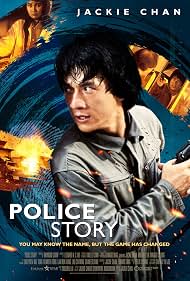
If you like action movies, comedy, crazy stunts and a Jackie Chan who seems to have absolutely no fear, then Police Story from 1985 is definitely worth watching. Directed by and starring Jackie Chan, this Hong Kong action-comedy is one of those movies where you sometimes wonder, “Did he really just do that?” The answer, in many cases, is yes!
The movie follows Hong Kong police officer Chan Ka-Kui, played by Jackie Chan. He is an honest and determined cop who is given the job of bringing down a powerful drug lord named Chu Tao, played by Chor Yuen.
The police set up a major operation to arrest Chu Tao, and Ka-Kui successfully helps capture him. Unfortunately, things quickly become complicated. Ka-Kui is assigned to protect Chu Tao’s secretary, Salina Fong, who has important information about the criminal organization.
Things get even worse when Ka-Kui is framed for the murder of a corrupt police officer. Suddenly, the honest policeman finds himself in trouble with the law and has to prove his innocence while trying to bring the real criminals to justice.
And, of course, this is a Jackie Chan movie, so solving the case involves a lot of running, fighting, crashing, falling and generally putting his body through things that no normal police officer would ever consider doing!
The movie has a great cast! Jackie Chan is the obvious star as Chan Ka-Kui, combining martial arts, physical comedy and impressive acting.
Brigitte Lin plays Salina Fong, the important witness who becomes caught up in the dangerous situation. Maggie Cheung plays May, Ka-Kui’s girlfriend. She brings some of the movie’s more comedic and personal moments, especially because Ka-Kui’s job keeps getting in the way of their relationship.
Chor Yuen plays the villainous crime boss Chu Tao, while Bill Tung plays one of Ka-Kui’s superiors. The supporting cast helps give the movie a nice mixture of action, comedy and crime drama.
For me, one of the biggest reasons Police Story is so much fun is the oldschool action. Jackie Chan doesn’t just fight people. He uses the entire environment around him.
There is a spectacular opening sequence involving a chase through a hillside settlement, followed by cars crashing through buildings. Then there is the famous scene where Jackie hangs onto a moving double-decker bus. Later, the movie finishes with an enormous fight inside a shopping mall.
The shopping-mall sequence is probably the part most people remember. There is broken glass everywhere, people flying through windows and Jackie fighting his way through the building. And then comes that stunt.
Jackie slides down a pole covered in electric lights from several stories up. The stunt looks completely ridiculous and incredibly dangerous—and that’s because it was. The lights heated the pole and Jackie suffered serious burns to his hands, along with other injuries.
One of the interesting things about Police Story is that the movie wasn’t constructed in the usual way. Screenwriter Edward Tang explained that Jackie Chan wanted the story to be built around exciting locations and props, such as a shopping mall, a bus and a village. In other words, the spectacular action helped shape the story rather than simply being added afterward.
Another interesting detail is that Jackie didn’t perform absolutely every stunt himself. Stuntman Blackie Ko doubled for him during a particularly dangerous motorcycle stunt involving glass. Even so, Chan personally performed many of the film’s most famous and dangerous sequences.
The movie was also a huge success and went on to win Best Film and Best Action Choreography at the 1986 Hong Kong Film Awards.
One of my favourite things about Police Story is the bloopers and behind-the-scenes footage at the end.
After watching Jackie Chan throw himself through glass, get smashed around, fall, crash and perform incredibly dangerous stunts, seeing the mistakes at the end gives the whole movie a completely different feeling. Suddenly you remember that these are real people doing these stunts—not computer-generated characters who can simply restart when something goes wrong.
The bloopers are also funny because Jackie and the other actors don’t always get everything right. You see failed takes, accidents and moments where the actors clearly can’t keep a straight face. It makes the movie feel much more human.
I especially enjoy this tradition in Jackie Chan movies because he doesn’t just want you to see the finished action. He also shows you some of the hard work—and sometimes the painful mistakes—that went into making it.
I really liked Police Story. It has everything I want from an old-school action movie: a fun story, memorable characters, comedy, martial arts, spectacular stunts and an absolutely crazy final act.
What makes it special, though, is Jackie Chan himself. He has a unique ability to combine action and comedy. One second you’re impressed by an incredible martial-arts sequence, and the next you’re laughing because he has fallen into something or accidentally made a situation even worse.
Even though the movie is now more than 40 years old, the action still feels impressive. There is a physicality to it that is difficult to recreate with modern CGI. You can see the danger, the timing and the effort involved.
For me, the bloopers at the end are the perfect finishing touch. After watching Jackie Chan spend the entire movie risking life and limb, seeing the mistakes and laughs behind the scenes makes you appreciate the film even more.
Police Story isn’t just a great Jackie Chan movie—it is a great example of why his style of action filmmaking became so famous around the world.
My verdict: definitely worth watching, especially if you enjoy action movies with a big dose of comedy!
Thanks for reading!