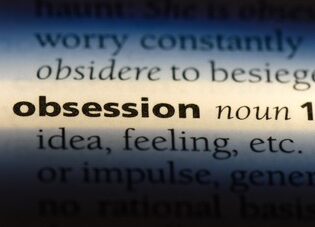
I’ve had an obsession, so I want to talk about it. About what it is, what the difference is between passion and obsession, whether some are more susceptible to it and how to stop it is 🧐
An obsession is a persistent, repetitive thought, representation, or impulse that imposes itself on consciousness and is perceived as disturbing or undesirable.
In psychology, this means that:
▫️The idea is difficult to suppress
▫️the person knows that he/she is excessive or unreasonable
▫️The thought causes tension, fear or anxiety
An important difference:
❗️Interest or passion: you like to think about it and it gives you energy.
❗️Obsession: the thoughts feel compelling, restless or annoying and cost energy.
Not every strong focus is bad. Great inventors, artists and athletes often had extreme passion. It only becomes problematic when you lose control.
By asking my question: are some people more prone to developing an obsession?
Some people are clearly more susceptible to developing an obsession than others. This usually has to do with a combination of predisposition, personality and circumstances. None of these factors work alone; they accumulate.
The most important factors at a glance:
▫️Personality and aptitude.
In other words, people who are naturally perfectionists, have a great sense of responsibility, think strongly analytically or controllingly, and are sensitive to uncertainty.
▫️Anxiousness
When you worry faster, assess danger, and keep repeating “what if” scenarios, your brain can get stuck in one thought to get a grip on fear. The obsession then feels like a (failed) attempt at control.
▫️Stress and major events
Obsessional thinking often occurs (or worsens) with prolonged stress, burnout or overload, loss, illness or trauma, and with major life changes. Your brain is then in survival mode and looking for a foothold.
▫️Neurobiological factors
In some people, certain brain circuits (especially around control, error detection, and recurrence) are more active. You can see this, for example, in OCD, but also milder in people without a diagnosis.
Important: this is not a weakness or character flaw.
▫️Education and environment
People who have grown up with a strong emphasis on avoiding mistakes, have little room for uncertainty, and high expectations sometimes learn that control = safety. This can reinforce obsessive patterns.
▫️Intelligence and creativity
A sharp and creative brain simply sees more connections, thinks deeper and longer, and is difficult to let go of ideas. That is a force, but without balance it can shoot through.
That was pretty confronting for me to be honest… all circumstances are pretty much perfect for me to be obsessive… But, I only had one last year, so that’s not too bad! 🙂
But I still want to know how to stop an obsession. Let’s see what the internet has to say.
Stopping an obsession is usually not about fighting it, but about dealing with it differently. That may sound contradictory, but it is the core.
Let’s take a look step by step.
❗️ First this ❗️
Obsessive thoughts:
▫️ are not a choice
▫️Say nothing about who you are
▫️Rarely disappear by simply quitting
The harder you push them away, the stronger they often come back.
Step 1 – Stop fighting the thought.
Don’t try to reassure yourself (it will be all right), analyze the thought, or prove that it is nonsense.
That feels logical, but it feeds the obsession.
It’s better to say, “Okay, there’s that thought again.”
Not good, not bad, just present.
Step 2 – Allow uncertainty. (however uncomfortable)
Obsessions are almost always about control and certainty. Try not to seek a definitive answer, let the inconvenience exist without action. Yes, this can be difficult, but it is precisely here that the obsession loses its power.
Step 3 – Don’t do compulsions.
Some obsessions encourage you to check, repeat, seek reassurance, and avoidance. Try to delay or avoid that behavior. Step by step, every little bit of progress is a win!
Step 4 – Focus your attention on something else.
Not as a distraction to escape, but as a choice. For example, move around, do something practical in or around your home, get creative, or connect with others.
The thought may be there, but you decide where to put your energy!
Step 5 – Be gentle with yourself.
Obsessions go well with self-criticism and shame. Rather, say to yourself, “My brain is trying to protect me, but it’s going on.”
Step 6 – When professional help really helps.
When an obsession takes a lot of time, limits your life and causes anxiety/sadness… then therapy is very effective.
Not because there is “something wrong” with you, but because your brain can learn new patterns more easily.
It was nice to do a short research and write about this. I understand myself a little better!
Thanks for reading and hopefully you enjoyed it too 🩷