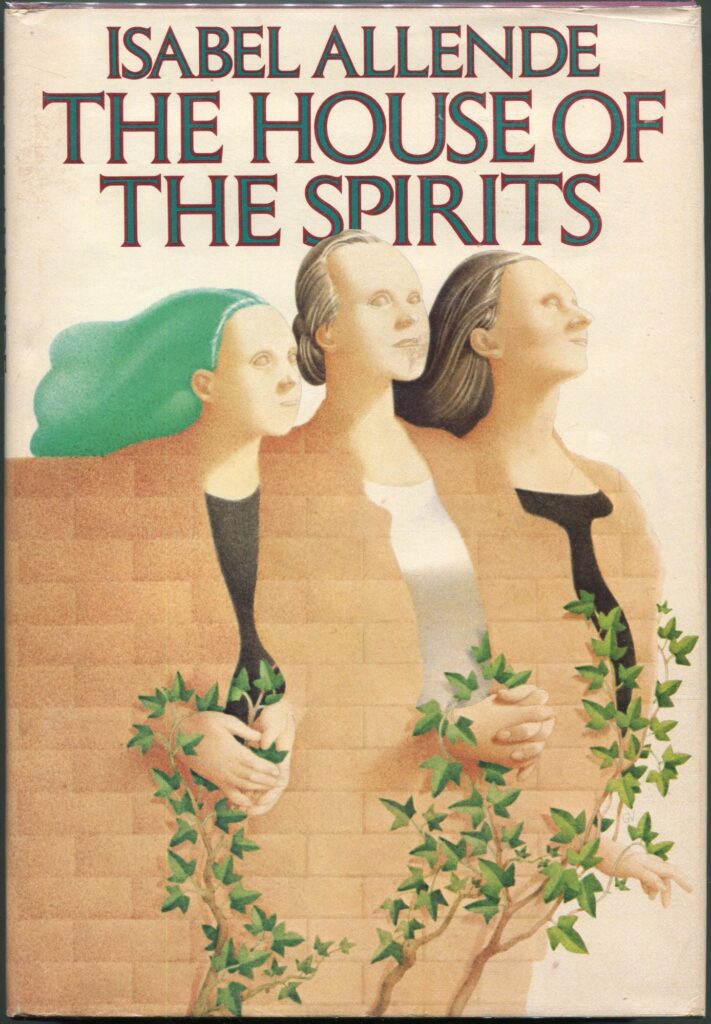
The House of the Spirits is the impressive debut novel of Chilean author Isabel Allende. First published in Spanish in 1982, the book is an unusual mixture of family drama, political history, romance and magical realism. It was honestly a rather weird book to read, but that strange quality was also what made it so refreshing and memorable.
I personally read it in Dutch. And I wanted to read it because Isabel is worldwide known author!
The story follows several generations of the Trueba family in an unnamed South American country that closely resembles Chile. One of its central characters is Esteban Trueba, an ambitious and hot-tempered man who rebuilds a neglected country estate and becomes a wealthy landowner and conservative politician. Esteban can be hardworking and determined, but he is also controlling, violent and cruel. His choices have consequences that continue to affect his children and grandchildren many years later.
Esteban marries Clara del Valle, a calm and mysterious woman who can predict the future, communicate with spirits and move objects with her mind. Unlike the characters around her, Clara treats these supernatural abilities as completely ordinary. Their daughter Blanca later begins a forbidden relationship with Pedro Tercero, a young man from a much poorer background. Their love story reflects the growing conflict between social classes. Eventually, Blanca’s daughter Alba becomes caught up in the political violence that takes over the country.
Although the novel begins like an eccentric family chronicle, it gradually becomes much darker. The private conflicts within the Trueba family are connected to larger themes such as inequality, revolution, dictatorship and the abuse of power. The final part of the book is clearly influenced by the 1973 military coup in Chile. This political dimension gives the story additional weight: the house is not simply filled with ghosts, but also with memories, secrets and the results of past violence.
At first, I found the novel quite strange. Ghosts appear without much explanation, characters have unusual names or abilities, and some shocking events are described in a surprisingly casual way. Time also moves quickly, sometimes covering years in only a few pages. There are moments when the story feels overcrowded because it contains so many characters, romances, tragedies and political ideas. Esteban’s violent behaviour can also make parts of the novel uncomfortable to read.
However, the weirdness eventually became one of the book’s greatest strengths. It was refreshing to read a story in which everyday life, history and magic exist together without clear boundaries. The supernatural elements make the family’s memories feel alive. They suggest that the past never disappears completely and that later generations continue to live with what their ancestors did. Allende’s female characters are especially memorable. Clara, Blanca and Alba survive in different ways, but each shows strength in a society largely controlled by powerful men.
Isabel Allende was born in Lima, Peru, in 1942, to Chilean parents. She later worked as a journalist in Chile. After the military coup, she went into exile in Venezuela, and her experiences of political upheaval and displacement strongly influenced her writing. The House of the Spirits began as a letter to her dying grandfather and developed into her first novel. Allende went on to become one of the world’s most widely read Spanish-language authors. Her own account of her life emphasizes family, compassion and helping others above literary success.
International reviewers have generally praised the novel. The New York Times Book Review admired its humanity and its combination of personal testimony with a broader portrait of Latin America. Publishers Weekly described it as both a compelling family saga and an emotional account of Chile, while the British magazine The Spectator praised its rich language and carefully constructed story. Kirkus Reviews considered it an absorbing Chilean family chronicle with clear characters and strong storytelling, although it also felt that the political message could occasionally become too forceful.
Overall, The House of the Spirits was not always an easy or comfortable book for me. It was strange, intense and sometimes confusing—but it was also imaginative, emotional and genuinely refreshing.
It offers much more than a ghost story: it is a novel about family, love, memory, injustice and the possibility of breaking a cycle of hatred.
I would recommend it to readers who enjoy unusual historical fiction and are willing to enter a world where spirits are sometimes easier to understand than human beings.
Thanks for reading 🩷
If you live in 🇳🇱 The Netherlands, you can oder the Nederlandse editie here and the English edition here!